
Fire departments are constantly asked to do more with less.
Beyond fire suppression, today’s fire agencies may be responsible for:
- Firefighter safety training
- Arson investigation
- Emergency pre-planning
- Community education
- Fire prevention
- Hazmat response
- Inspections
- Active threat response
- and more.
Whether your department is career, volunteer, or some combination of the two, the need for updated training and investigation tools, like OSCR360, continues to grow.
Yet, funding can be a challenge.
Many fire agencies rely heavily on municipal budgets, tax dollars, or special district funding. These are important and necessary revenue streams, but they do not always cover new technology, training tools, or investigative equipment. That is why many departments look for additional funding sources, such as grants, public-private partnerships, and community-based support.
This means there may be several ways your agency can get help with funding an OSCR360 purchase.
Why are Fire Agencies Investing in OSCR360?
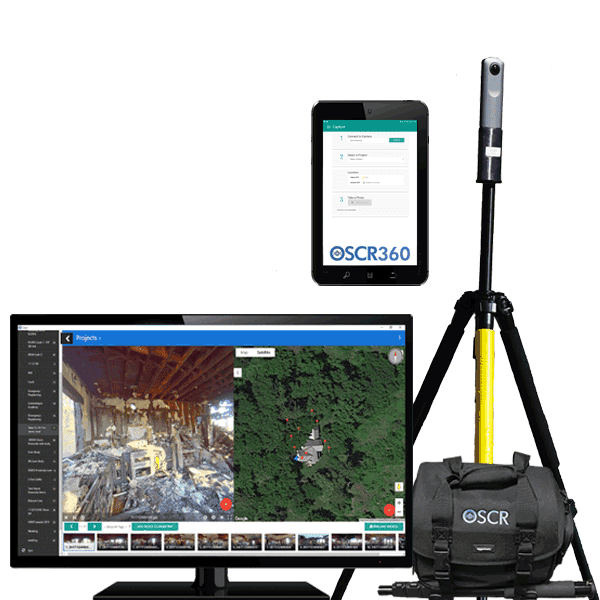
OSCR360 is a multi-use system designed to help public safety agencies capture, organize and present 360-degree images of a fire scene, business, or public facility. For fire departments, OSCR360 can assist with:
In-house training and re-training
Firefighters can virtually revisit past fire scenes, review response strategies, discuss safety considerations and train on fire behavior, ventilation, origin and cause, building layouts, and more.
Arson and fire investigations
Investigators can document a scene in 360-degrees, build their case, identify points of interest, organize evidence, and present the investigation in a clear, easy-to-follow format.
Emergency pre-planning
Agencies can document schools, casinos, entertainment venues, manufacturing facilities, chemical plants, hospitals, government buildings and other high-risk or high-occupancy locations within their jurisdiction.
Cross-agency communication
OSCR360 projects can be shared with law enforcement, command staff, prosecutors, school safety teams, facility managers, and other approved stakeholders using the viewer-only software.
Because OSCR360 can be used across many areas of fire service, agencies may be able to connect the purchase to more than one funding priority.
Funding Sources for Fire Departments: Community Partnerships
Fire departments serve everyone. In many communities, there are businesses, venues and organizations that have a clear interest in fire safety, emergency preparedness and first responder readiness.
These organizations may be willing to partner with the fire department to help fund a tool like OSCR360, especially when they can see how it supports training and pre-planning for their own facilities.
Casinos and gaming facilities
Casinos are often large, complex environments with high occupancy, multiple entrances and exits, security areas, kitchens, hotel spaces, entertainment areas, parking garages and back-of-house operations.
A casino may benefit from partnering with the local fire department to document the property in OSCR360 for emergency pre-planning and firefighter familiarization.
With an OSCR360 project, first responders can virtually walk through the facility before an emergency occurs. Firefighters can review building layout, access points, stairwells, alarms, sprinkler systems, electrical rooms, kitchens, hazardous areas, security checkpoints and evacuation routes.
This type of preparation can help both the department and the facility feel more confident in the event of a future emergency.
Entertainment venues and public assembly spaces
Concert halls, arenas, theaters, stadiums, hotels, convention centers, restaurants and large event spaces all have unique emergency response considerations.
These locations may include dense crowds, limited exits, changing floor plans, temporary equipment, pyrotechnics, commercial kitchens, elevators, back-stage areas, and complex evacuation needs.
A local entertainment venue may be a natural partner for an OSCR360 project because the tool can be used to document the facility, support training, and improve situational awareness for first responders.
The department can use the project during downtime or during designated training. Command staff and firefighters can review:
- Entrances and exits
- Evacuation routes
- Hydrant access
- Alarm panel locations
- Utility shutoffs
- Stairwells and elevators
- High-risk areas
- Areas where large crowds gather
- Locked or restricted-access areas
For the venue, this partnership shows a commitment to guest safety, staff preparedness, and community collaboration.
Chemical manufacturers and industrial facilities
Manufacturers, chemical plants, warehouses, refineries, and industrial facilities may present unique hazards for fire departments. This includes flammable materials, hazardous chemicals, confined spaces, machinery, electrical hazards, water hazards, storage areas, and complex facility layouts.
Because of these risks, private companies may have a strong interest in helping the local fire department better understand their environment before an incident occurs.
OSCR360 can be used to virtually document facility hazards, points of access, shutoffs, chemical storage areas, fire suppression systems, and evacuation routes. The department can then use the project for training and emergency pre-planning.
For businesses, this is more than a donation. It is an investment in preparedness, safety, and continuity of operations.
Schools, colleges, and universities
Many fire departments already partner with local school districts and campuses for inspections, emergency planning and active threat preparedness.
Schools and universities may consider helping fund OSCR360 if the system will be used to document school buildings, athletic facilities, dormitories, labs, cafeterias and other campus spaces.
OSCR360 projects can be valuable for fire response, law enforcement response, EMS coordination, reunification planning, and tabletop training exercises.
Hospitals and healthcare facilities
Hospitals, assisted living facilities, nursing homes and healthcare campuses serve populations that may need extra assistance during an evacuation.
These facilities may also include oxygen storage, laboratories, kitchens, locked units, elevators, backup generators, and complex floor plans.
Partnering with the local fire department to create OSCR360 walkthroughs can help responders better understand the facility before an emergency, including where vulnerable populations may be located and how to access critical areas.

Funding Sources for Fire Departments: Grants for Agencies & First Responders
Grants are another important funding source for fire departments and first responders. Grant opportunities vary by year, state, region, and agency, so it is important to review eligibility requirements and application deadlines carefully.
Some grant programs may support training, equipment, firefighter safety, fire prevention, investigation tools, technology, preparedness or community risk reduction.
Assistance to Firefighters Grants (AFG)
The Assistance to Firefighters Grant program is one of the most recognized federal grant opportunities for fire departments. AFG is designed to help fire departments, non-affiliated EMS organizations and state fire training academies obtain critical equipment, training and resources.
Depending on the current year’s guidance, AFG funding may support training, equipment, wellness initiatives, PPE, vehicles, facility modifications, and other operational needs.
If your agency is applying for AFG funding, consider how OSCR360 supports training, firefighter safety, operational efficiency, documentation, and emergency preparedness.
Staffing for Adequate Fire and Emergency Response (SAFER) Grants
SAFER grants are focused on staffing, recruitment, and retention. While SAFER may not be the right fit for an equipment purchase, it is still an important program for departments seeking to improve response capabilities and maintain adequate staffing.
Volunteer departments may also want to review SAFER recruitment and retention opportunities if staffing levels are a challenge.
Homeland security and emergency preparedness grants
Some departments may also be eligible for homeland security or emergency preparedness funding, especially when the project supports critical infrastructure, active threat response, public assembly venues, school safety, emergency planning or regional preparedness.
State and local grant programs
Many states offer grant programs for fire departments, EMS agencies, and first responders. These may be administered by state fire marshal offices, homeland security agencies, emergency management offices, public safety departments, or regional councils.
State-level grants may support small equipment purchases, training, technology, communications, fire prevention, hazmat preparedness, arson investigation, or emergency management.
Private and corporate grants
Private companies, community foundations, insurance providers, utility companies and local charitable foundations may offer grants for public safety, emergency preparedness, or community resilience.
These opportunities may be especially relevant when OSCR360 will be used to document high-risk community spaces, train responders, or strengthen emergency plans.
Examples include:
- Gary Sinise Foundation Grants
- Firehouse Subs Public Safety Grants
- State Farm/ NVFC Good Neighbor Firefighter Safety Program
- Walmart Spark Good Local Grants
- Enbridge Safe Community First Responder Program
Funding fire department technology takes teamwork
Fire departments are essential to every community, but funding does not always keep pace with the growing demands placed on first responders.
By exploring grants, local partnerships, private funding, civic support and regional cost-sharing, fire agencies may be able to secure technology tools like OSCR360 without relying solely on their annual budget.
At L-Tron, we are proud to work alongside public safety agencies, listening to the voice of first responders and building technology around their real-world needs.
Interested in learning more about OSCR360 for your fire department? Contact the L-Tron team to discuss how OSCR360 can support your agency’s training, investigations and emergency preparedness goals.

Your Success is Our Purpose!